Children's Ministry Curriculum Planning: Why It Feels Like Hitting a Moving Target
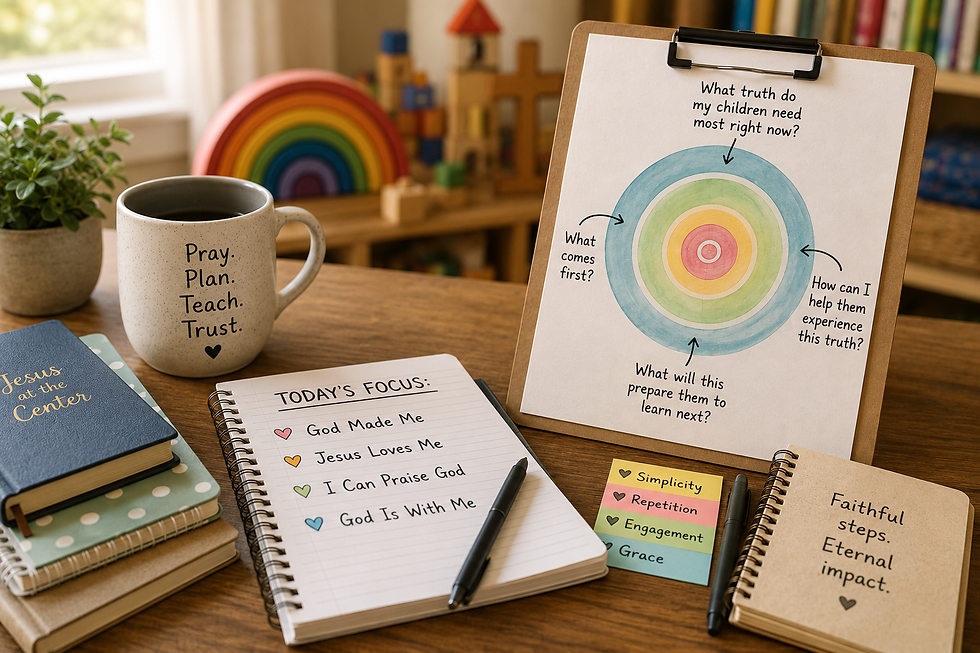
When I first started creating curriculum for toddlers, I thought the biggest challenge would be deciding what to teach.
In some ways, I was right.
Choosing what to teach is a huge part of the process. Sometimes you spend months building a curriculum plan only to realize it isn't connecting with the children the way you hoped or it's too advanced. Sometimes the needs of the group change so much that you have to set aside what you've created and start fresh. It's part of the process, but it can be frustrating.
I learned pretty quickly that curriculum planning isn't something you do once and then forget about.
Children change.
The ones in front of you today may not be exactly the same group six months from now. As we spend time with them, we begin to notice new strengths, new challenges, and new ways they learn best. Importantly, we sometimes realize we have missed teaching important truths that we assume go without saying.
But for toddlers, nothing goes without saying.
We are teaching the things that go, from scratch.
We can hit all the points: story, lesson plan, craft, songs. But the truth is, we are trying to teach the most basic introduction to Christianity, a paradigm that is massive and forever expanding. It's hard to know exactly what to teach and when.
There are no wrong answers if you're teaching the true Gospel. But depending on the group you're teaching, there are many factors to consider in deciding how and where to start. We have to answer the biggest question of all:
Is this the truth I need to be teaching right now and, if so, how can I present it in a way that matches the needs of my students?
That's why curriculum planning often feels like trying to hit a moving target. Sometimes we're adjusting activities and teaching methods. Other times we're rethinking entire lessons or rebuilding sections of the curriculum altogether so we can better meet children where they are and help them grow.
There Is More Than One Right Answer
One of the things I've discovered while developing curriculum is that there are often multiple good directions you could take a lesson. Should you focus on God's love? Should you focus on prayer? Should you focus on worship? Should you focus on creation? Should you focus on obedience? All of these topics are important, and all of them are true.
The challenge isn't deciding whether these truths matter. The challenge is determining which truth will best serve the children sitting in front of you right now and what order those truths should be presented in so they can be understood, retained, and built upon in the future.
That sounds simple enough, but in practice, it rarely is.
Sometimes you spend weeks planning a series only to realize the children need a stronger foundation somewhere else. Other times you discover that a concept you assumed they understood has never actually been taught. Still other times you find yourself realizing that a lesson works perfectly on paper but isn't connecting in the classroom.
The more I work with curriculum, the more I realize that every answer creates another question. Just when I think I've identified the next truth to teach, I begin wondering whether there's another foundation that should come first.
Building a Foundation, Not Filling a Calendar
One of the easiest mistakes curriculum writers can make is treating curriculum as a checklist. Did we cover the story? Did we complete the craft? Did we finish the lesson? Those things matter, but they aren't the goal. The goal is helping children build a foundation of truth that can support deeper understanding later.
When I look at curriculum now, I spend less time asking what story should come next and more time asking what truth should come next and how I should present it. Before children can understand God's purpose for their lives, they need to understand that God made them. Before they can understand salvation, they need to understand that Jesus loves them. Before they can understand worship, they need opportunities to experience praise. Before they can understand God's faithfulness, they first need to understand that God is present.
The more I build curriculum, the more I find myself asking what comes first. Not because some truths are more important than others, but because understanding often builds upon understanding. Children need a place to stand before they can climb higher. That means curriculum planning is often less about deciding what to teach and more about deciding what foundation needs to be laid next, and simpler still, what are the foundation stones?
The Christian faith is far too large to teach all at once. Curriculum planning often becomes the process of deciding which brick belongs next in the foundation. Not because the other bricks aren't important, but because foundations are built one layer at a time.
Three Questions I Constantly Ask
Something I am trying to always remind myself is its not my job to figure out what I should teach. It's my job to seek God about what He wants me to teach. We can think we know what a child needs or how they might receive a lesson, but my best experiences have come from listening to the quiet voice of God advising me what to do, how to do it, how to teach, and what to try.
These are some of the questions I ask when I think about curriculum building:
1. What Truths Do My Children Need Most Right Now?
Not next year.
Not when they're older.
Right now.
Every group is different. Some children need encouragement. Some need stronger foundations. Some need opportunities to engage with truths they've already heard. Some need basic concepts that we mistakenly assume they already understand.
Understanding the needs of the children helps shape the direction of the curriculum.
2. What Does This Truth Prepare Them to Learn Later?
This is a question I didn't think about much when I first started planning lessons, but now I think about it constantly. Every lesson is preparing children for future understanding. The truths we teach today become the building blocks for the truths they will learn tomorrow.
That's one reason I spend so much time thinking about sequence. It's not simply about what children learn. It's also about what that lesson prepares them to understand next.
Curriculum isn't just a collection of lessons.
It's a pathway.
3. How Can I Present this Truth in a Way that is Understood?
Information alone rarely changes people.
Experience matters.
Children need opportunities to see, hear, sing, move, create, participate, and interact with what they're learning. The goal isn't simply presenting truth. More importantly, it's helping truth become memorable.
That's why curriculum planning isn't only about content. It's also about delivery. A wonderful lesson can be forgotten quickly if children never engage with it. On the other hand, a simple truth that is experienced through songs, stories, movement, crafts, and repetition can stay with a child for years.
Faithfulness Over Perfection
Perhaps the most important lesson curriculum planning has taught me is that there will never be a perfect curriculum.
There will always be lessons you wish you had written differently. There will always be activities you would change. There will always be truths you wish you had introduced sooner. That's simply part of ministry. Our responsibility isn't to create perfect curriculum. It's to faithfully teach the children God has entrusted to us.
Sometimes that means staying the course. Sometimes it means making adjustments. Sometimes it means rewriting an entire month because you've realized something important is missing. None of those things are failures. They're part of the process.
If anything, they are evidence that we are paying attention to the children God has placed in our care.
Hitting the Target in Children's Ministry Curriculum Planning
Children's ministry curriculum planning often feels like trying to hit a moving target because the children we're teaching are constantly growing, changing, and developing. The target moves. The needs change. The answers to those three questions evolve. And yet, the mission remains the same.
We are helping children take their first steps into a faith that is far bigger than they can currently understand. Every lesson, every story, every song, and every activity is another opportunity to place a piece of truth into a child's life. We may not always know which lesson will connect.
We may not always know which truth will take root, but we can faithfully continue planting seeds and trust God with the growth. In the end, that's what curriculum planning is really about. We prayerfully lay our efforts at His feet and know that He will use it for His purposes and His glory.
My Prayer:
Father, help me to seek you first when its that time again and I'm thinking on what to teach. I want to teach your living lessons, not my dead ones. Keep me coming back to Your Word for guidance over and over again. Amen.



Comments